Hard problems are just small ones, tangled together.

Every system is built on patterns. Craftloop's work is finding the small problems inside a hard one, solving each in a fast loop, and shaping the custom patterns that tie them into software people rely on. Scroll to watch it happen.

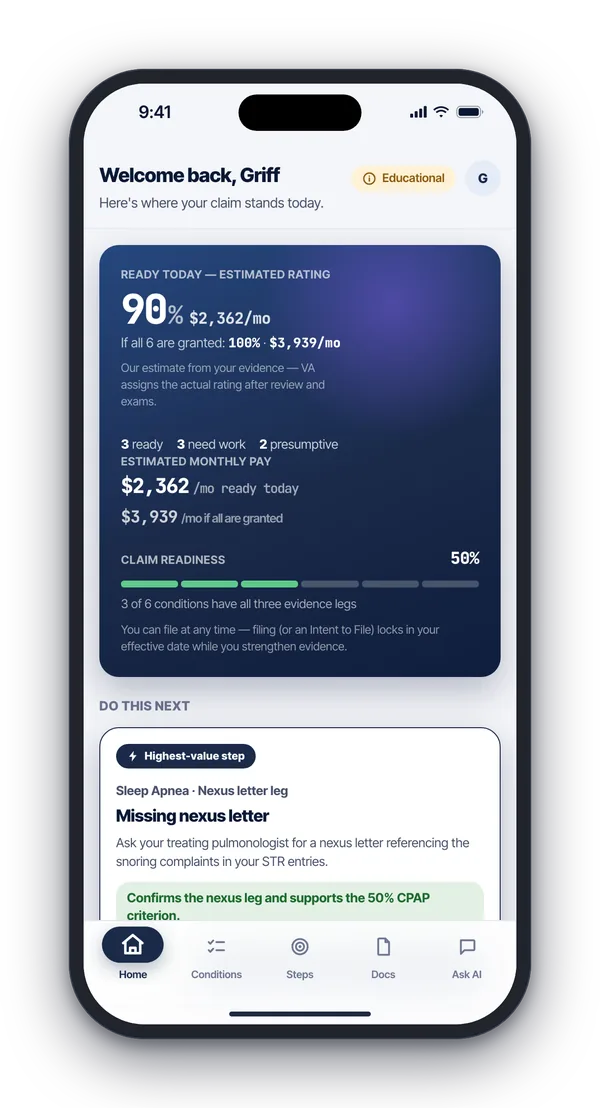
After Duty running on an iPhone, showing the home screen for a synthetic veteran.

Step 1

Start with the hard problem.

Take After Duty: help veterans understand their own records and organize them for a VA disability claim, whether they prepare it alone or with a service officer or accredited attorney. Up close, a problem like that is a tangle of hundreds of pages of records, a rating schedule written as regulation, and rules that interact.

Step 2

Break it into small problems.

Every tangle is made of pieces small enough to solve well:

  • Read each record and pull out the facts, with citations
  • Find every condition the evidence supports
  • Match each one to the rating schedule
  • Do the VA math exactly
  • Show what evidence is still missing, before the VA has to ask
  • Make all of it work on any phone
Step 3

Solve each one in a fast loop.

Build it, test it, verify it against real cases, ship it. Then take the next piece. Small loops mean you see working software every few days instead of a big reveal months from now, and every small problem is solved before it can grow into a large one.

Step 4

Let the patterns show.

As pieces are solved, they line up. The way one document is read becomes the way every document is read, and the check on one estimate becomes the check on all of them. Those patterns become the system: crafted for your problem, not borrowed from a template.

Step 5

Ship a system people rely on.

The result feels finished because every piece was finished. After Duty is built for the web, iPhone and Android, and backed by about 1,900 automated tests across the API and the app.

Fast, in numbers.

Small loops add up. The numbers come straight from the two products' version history.

44VolunTails releases between August 10 and November 5, about one every two days
1,500+VolunTails commits since it started in May 2026
1,000+After Duty commits since it started in October 2025

Why I build

I'm a veteran, and I choose to build software that serves and supports others. I've seen the work up close: the effort behind a VA claim, the dedication it takes to run a shelter on volunteer power, the care behind helping a child learn in the way that fits them.

Craftloop is one engineer, backed by 15+ years of software engineering, 8+ years of military service and 8+ years of academic work. I start every project by studying the problem and listening to the people who live with it, because understanding matters as much as speed. Then I build with proven engineering practice, directing AI agents through each loop where they help. The agents take on the volume; I make the calls, hold the standard, and answer for the result. You get the speed of a team and one person who owns it all.

What the name means

Craft is the engineering skill to see the pattern in a problem and give it shape in code. Loop is that skill made repeatable: build, test, verify, refine, with each pass feeding the next so the software gets stronger with every release.

The logo is a loop of four quarter tiles with one lifted out: the piece being crafted right now. When it's done, it drops back in and the loop closes. Then the next one lifts.